
I feel like I spend a lot of time on the internet looking for an answer.
Where is the next job? What should I write about? What skills should I pick up? Why didn’t I learn how to be an AI engineer or just generally, a computer engineer? Why did I love English instead of building cars? How do I break into a network?
It’s an endless loop of questions and ideas being punched on search engines and chatbots and emails. Being on the keyboard feels like I am digging for water in a desert sometimes.
I’m not alone. Take Sean Wittmeyer featured in The New York Times by Noam Scheiber. Sean is a person with a decade of experience, two masters degrees, product and architecture design. Easy hire. And yet:
…Mr. Wittmeyer, 37, has been unemployed for a year and a half, since he lost his job in business development for a company that makes software to help with real estate projects. He has been so eager to earn income that he has applied for positions befitting an intern, only to be told he was overqualified. “I can’t even work at the little board game store down the street,” he said.
When the federal government released its August employment numbers on Sept. 5, the overall unemployment rate was still relatively low, at just over 4 percent. But underneath was a concerning statistic: The portion of unemployed people who have been out of work for more than six months, which is considered “long-term,” rose to its highest share in over three years — to nearly 26 percent.
Unemployment hovers around 4%, but about one-third of the long-term unemployed are the college educated — a trend that has increased over from one fifth, a decade ago.
It’s hard to explain these college educated long-termers. But one reason is offered from Scheiber:
But employers also appear to have less need for college-educated workers, driven by technological change, automation and, most recently, President Trump’s cuts to federal workers and funding, which have disproportionately affected the college educated.
As of this writing, I am close to joining this cohort. I am one of these college-educated long-term unemployed people. I have a master’s and 15 years of professional experience from hospital to media to classroom experiences. And three years of combined service to Peace Corps and AmeriCorps.
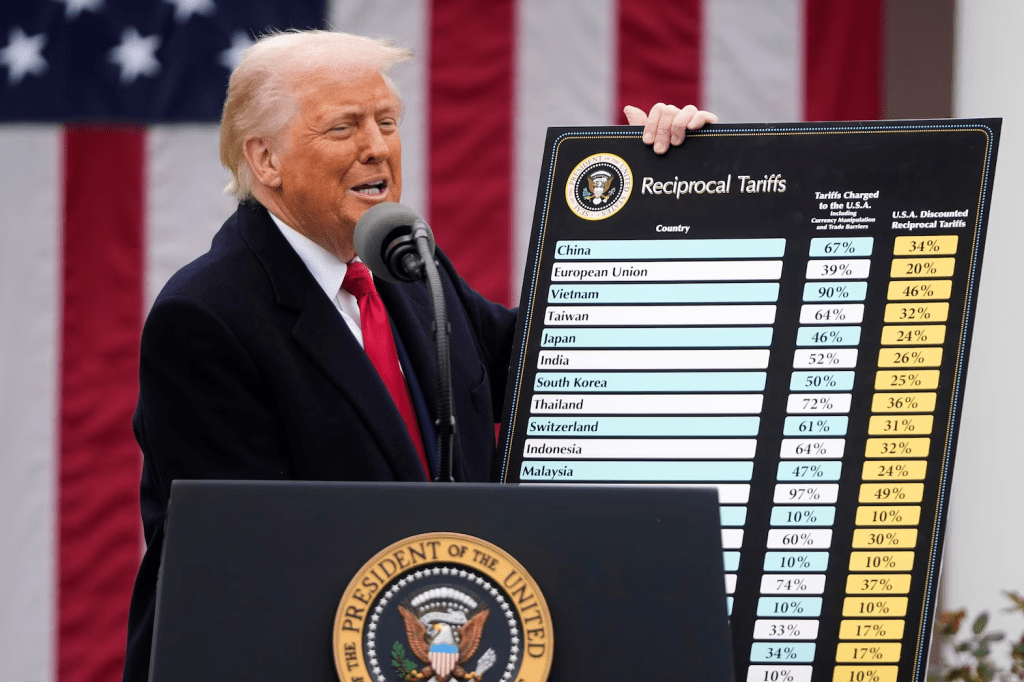
This isn’t my fault. It wasn’t my talent or experience or my personality that got me laid off. I was laid off because of the economy. Because Trump came out of the White House with a board and announced “Liberation Day” on April 2, 2025. Eight days later on Thursday, April 10th, it became “laid off” day for me.
It was the economy was, I was told. I was on a Zoom call while on vacation at my grandparents’ house. I was debating sending an offer on a house in a new state; our small family was looking to move very soon. Getting laid off feels empty and sinking — like a pine needle half-eaten chewing gum goop poured all over your body.
My brain searched for answers. Liberation Day made the economy wacky for a few weeks. Tariffs, and a host of other factors, continue to make the economy rocky; or strange, at best.
But if the economy caused my layoff, it’s weird to read headlines like, America’s economy defies gloomy expectations from this September. It’s odd to hear the unemployment number is low and then read fewer employers are hiring. It’s bad, it’s not bad.
And yet, I still wonder: Did I need to be laid off when I had a newborn and in the middle of prepping to move across the country? Did (do) I need to go through six months of unemployment, applying to dozens of jobs, and dealing with an untold heavy matter of stress and struggling with self worth? Did I need to be put into this state of endlessly digging for an answer?
It sucks when things are out of your control. For me, I try to gain control. I try to fire up the internet and my phone and launch a thousand messages, grab links, hoard advice, upload new skills as if skills were a piece of software I could tinker into my brain. You know, transform — have some gym trainer in my head with Arnold Schwarzenegger swagger who says, “You can do it!” You can be someone new! You can get a job!”
Like if you do 50 pushups, you’ll be on the road to transforming; you’ll be better. You’ll be closer to an answer. Apply to 50 jobs, and you’ll be better. You just have to do this and this.
But I still feel that fear. Fear my skills, my schooling, my opportunity to build skills and experiences were wasted; they aren’t enough. The fear vaporizes the imaginary Arnold trainer.
Right now, job searching feels like a playing slots. You have to know a casino manager to get an advantage, or a nice room at the hotel at least. Even then, you’re not guaranteed to be seen by the algorithmic gods flicking through the millions of job applications. It’s hard to stand out, it feels.
All of this means I’m trying to find an answer and explanation. I feel the skills and the things I’ve done should equal stability and a job. But, like many, past skills and college education and good experiences don’t equal an easy job placement. I’m lucky enough to have a stable partner with a job that has kept us afloat, and I feel a tremendous amount of love in my corner. I’ve loved spending so much time with my new and first born kiddo. I’ll look back and not regret a moment of this time I’ve had.
But a feeling and need to do something still nags. With unemployment payments have ran their course (a little over $1000 a month now gone), I need to get a job.
Sometimes I trade the keyboard for the notebook. Five minutes, thirty minutes with a notebook can boost the mood. Music. Just pour out thoughts — the questions and fears.
There isn’t really an answer to such calamities of being laid off and not being able to find a job. Especially when you feel like you’re a good employee and want to contribute. There’s not an easy fix.
This doesn’t give me an answer but it makes me feel better. Gives me a chance to calm my head. In that space of writing with just paper and pen. In that slow boredom and steady pace of ideas, something emerges. A simple state of an answer — the raw signal of one — shows up. An answer that says you’re enough; keep trying.
 Old Fashioned News
Leave a comment