Since June, I’ve been a producer for the Monday Eight O’Clock Buzz with long-running host Brian Standing at WORT 89.9 FM. Recently, and with the graces of the news director, I tried something new.
As an experiment, I wrote a text-based version of the radio with further context, news story links, and links to the audio versions. The idea is to give people a text-version while providing further information to the related story. Reposted, the written text is below.
In addition, I also made a social post video for one of the stories that now lives on WORTFM’s Instagram.
Both of these are meant to be their own product, but flow from the main product: the hour-long news and talk show.
For the text-based post, it will as running series of “Producer Notes” for the Monday Eight O’Clock Buzz. I think making this a newsletter could be a good idea, too. More to come later. See original post at wortfm.org website.
On Monday, September 15, 2025 with host Brian Standing, we had a running theme on the Eight O’ Clock Buzz: sustainability. That’s what I heard as a producer. Here were the three stories from the Monday show:
1: Data centers threaten sustainability in Wisconsin. Our first guest was Amy Barrilleaux, the Communications Director at Clean Wisconsin, a local science-based advocacy organization fighting against climate change and pollution.
Plans for data centers in Wisconsin are underway across the state: Port Washington, Kenosha, Beaver Dam, Mount Pleasant, Menomonie, and the Town of Vienna in Dane County, to name some. Each of these plans is in flux and fall in differentness stages of development.
In the case of Wisconsin Rapids, a plan to build a data center has been canceled. And with Mount Pleasant — where Microsoft is planning to build a data center — environmental advocates are suing the city of Racine demanding transparency over how much water will be used in a 210-day period.
On the show, Barrilleaux points out the potential environmental harm and heavy resource use of data centers , including water usage. A day after visiting our WORT, her organization, Clean Wisconsin released an analysis claiming that AI data centers will use more energy than all of Wisconsin homes.
These are all developing stories to follow. Barrilleaux came to the station with numbers and facts about how much energy and gigawatts and water these proposed projects will take up. She wants the public to advocate for a pause so they can find out the facts, understand what each data center will require and whether it’s worth the cost to build.
This raises the question: Why build a data center?
“Local communities are sort of hard wired to think this is an investment. This is billions of dollar of construction,” Barrilleaux told Brian Standing. “We’re going to make revenue for our community off of that. It’s really, really tempting.”
She goes on to point that Wisconsin has lots of land and water. (Our state is often called a “climate haven.“) So, tech companies to build here. Rural communities feel the temptation to trade farmland for data land. To a “revenue poor” community, a promise of money from wealthy technology companies, is tempting.
Even with the promise of revenue, many Wisconsinites may share comedian, podcaster, and best-selling author Charlie Berens’s feeling towards the data centers, “I don’t want Wall-E, I want walleye.” Lakes and water over robots and servers.
2: In death, go green: Anita Lawrence is the Director of Community Relations for Sòlas Natural Burial Preserve in Middleton, Wisconsin. She opened the conversation talking about what led her to this work: her own mother’s green burial site. Lawrence was struck by the experience of passing around a stone, saying something about her passed mother, and burying the stone with her mother. Flowers weren’t allowed.
“It was beautiful,” Lawrence said at the station. A green burial has less stuff than traditional burial. No chemicals, toxins, or artificial materials going into the ground. As the Sòlas website states:
We strictly prohibit embalming, caskets, metals, plastics, chemicals, headstones, concrete, vaults, and all synthetic materials. Native plants, trees, and flowers are used as an alternative to headstones, and all burials are marked by GPS.
If your into this subject — a subject we all have to face some day — Caitlin Doughty’s is another strong resource with her organization The Order of the Good Death.
3: Artists in the library: Ellie Braun is the Bubbler’s current Artist-in-Resident at the Pinney Library here in Madison. She also joined us in-studio on Monday to chat about her process, her months-long work, teaching adults how to make art at the library. Ellie uses sticks, secondhand fabric, and other used materials. She makes wall hangings, textiles, tapestries, pillows, hanging sculptures, think-piece wearables. She views the elements of an art piece as something that can shift or change over time — in not just physicality, but also meaning, too. As she told Standing:
A lot of my inspiration comes from nature. And with that cycles of decay and growth. And I think that’s something we’ve become removed from as humans. We are so used to trying to make things that will last forever, but I think it’s also important to think about how things can change. You have to go through decay in order for there to be growth.
Braun is calling for viewers of her art to think about how people can change. Flexibility should be a consideration, and having the capacity to change within our selves. The idea reminds of a concept called proteanism that I got from psychiatrist and psychoanalyst Robert Jay Lifton. It’s an idea that life is an experiment, an exploration, and change can be a part of it. We can change for the better. That’s what I think of when I hear Ellie Braun talk about her art.
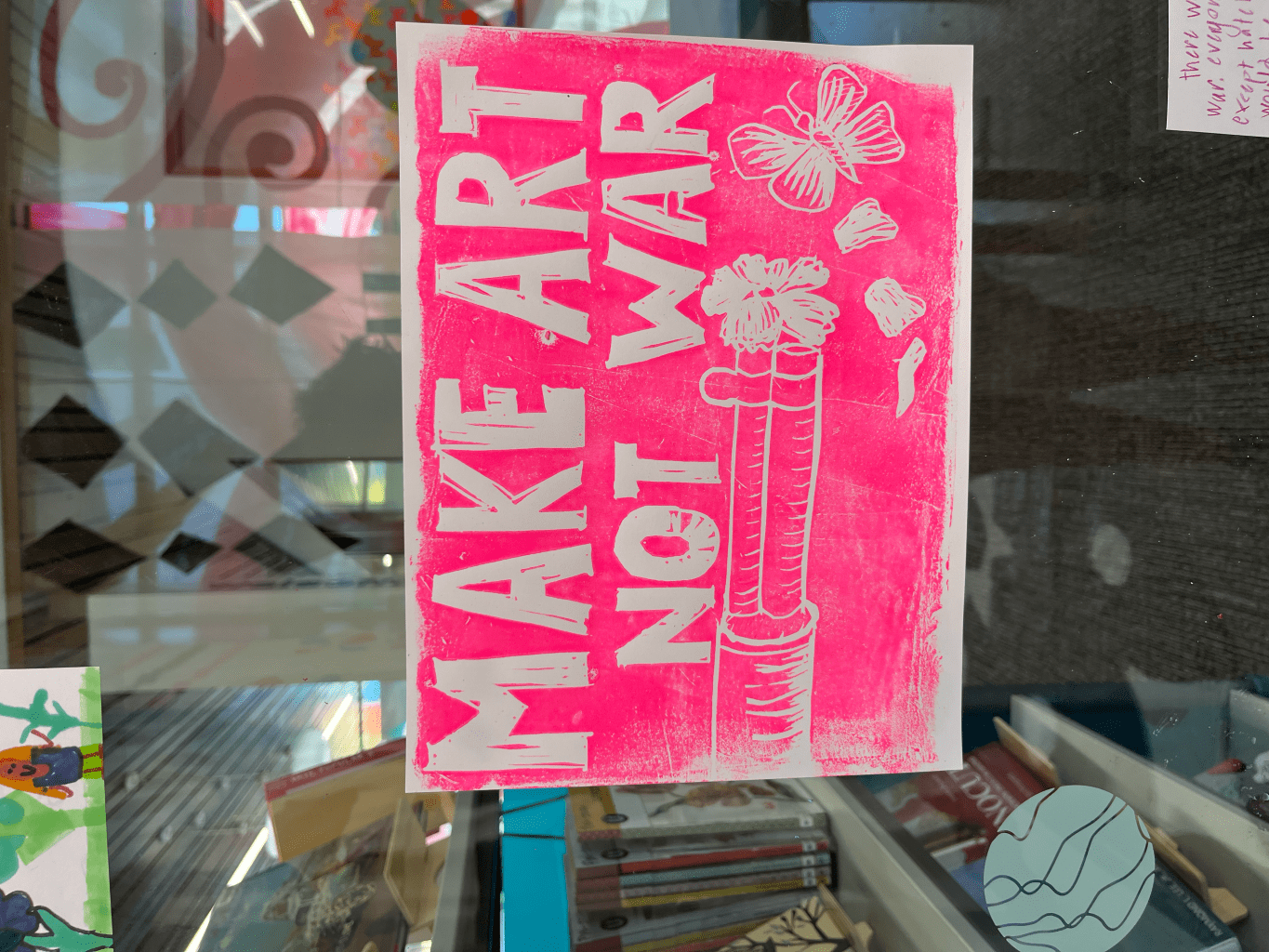
I visited Ellie later on Monday at her studio at Pinney. She was in a glass-walled room. Art seemed to be a part of the room more than just pictures hanging on the wall in frames: a corner of the floor was covered in textured work of art, banner-like cloth waved from the walls, clusters of sticks and yarn glinted in the sunshine from window suckers; silkscreen supplies leaned near the sink; cardboard flowers hung on a wall.
I made a social post for WORT that shows Braun’s studio that you can see on WORTFM’s Instagram.
Thanks for reading, Tucker Legerski
 Old Fashioned News
Leave a comment